|
Description / Habitats / Flora / Vertebrates / Insects / Invertebrates / What's that Bug? Home / Nestos Delta / Bibliography / About this site / Links / Contents / Galleries ____________________________________________________________________________ |
GRASSHOPPERS AND THEIR ALLIES (ORTHOPTERA
AND DICTYOPTERA) The Orthoptera are a prominent feature of the wildlife of the Mediterranean, from the ubiquitous trilling of the bush-crickets to the splash of colour from the hind-wings of grasshoppers as they fly up beneath your feet. The songs of the Orthoptera fill the air from hedgerows and scrub but it can be very difficult to locate the source and identify the species involved. Around towns, such as Limenas, I suspect the tree-cricket Oecanthus pelluscens is the main species involved, although it would also appear that house crickets Acheta domestica are also widely distributed given the chorus that emanates from many balconies at night. It is also at night that the preying mantis Mantis religiosa is most often seen as adults frequently visit artificial lights, presumably attracted by the presence of numerous moths. During the day, many different grasshopper species can be flushed on walking through rough grassland in the lowlands. Two of the more conspicuous are the blue-winged grasshopper Oedipoda caerulescens and the red-winged Oedipoda miniata. The colour is only briefly exposed in flight and once at rest the grasshoppers are camouflaged against their background once again. The first author to report on the Orthopteroids of Thásos appears to have been Werner (1938), recording five bush-cricket and eight grasshopper species. In October 1942 and June 1943 Marinov (1959) undertook a survey of the Orthoptera and related Orders, recording 21 species (plus two earwigs). In light of recent taxonomic revisions, Dr Arne Lehmann has pointed out that some of Marinov's records are probably invalid and require confirmation. Kaltenbach (1965) reported on the species he recorded during day visits to Thásos in July 1962 and July 1964, recording twelve species. Willemse (1984), in his thorough review of Greek Orthoptera (sensu stricta), reports 20 species as occurring on Thásos, including records for two species (Decticus verrucivorus and Eupholidoptera smyrnensis) not reported from Thásos by earlier authors. Gorochov (1995) described the scaly scricket Pseudomogoplistes byzantius from specimens collected in several countries, including a male captured on the beach at Limenaria, Thásos, in 1990. Ciplak et al. (2007) include a record of E. smyrnensis from Thásos. From my own observations I can add another seventeen taxa: the striking diminutive cockroach Phyllodromica marginata, frequent amongst leaf litter in old olive groves; the mantis Geomantis larvoides (common on Skala Potamias dunes); the ground-hopper Paratettix meridionalis; the crickets Trigonidium cicindeloides and Arachnocephalus vestitus; the tree-cricket Oecanthus pelluscens; the bush-cricket Sepiana sepium, the house cricket Acheta domestica; the pygmy mole cricket Xya pfaendleri; and the grasshoppers Acrotylus insubricus, Acrotylus longipes, Chorthippus bornhalmi, Oedipoda germanica, Omocestus rufipes and Platypygius crassus. Specimens of the diminutive ant-cricket Myrmecophilus cf. myrmecophilus were collected from the Ipsarion uplands in 2001 & 2007 and Thomas Stalling considers that they may represent an undescribed species. I have also seen mole crickets Gryllotalpa sp. in several localities, notably the Agora in Thassos Town and alongside a sandy river at Skala Potamias where hundreds of mole crickets had burrowed into the newly dredged banks of a sandy watercourse. Whilst Kaltenbach (1965) records G. gryllotalpa from the adjacent mainland coast, it is now known that two similar species occur in Greece, only separable at present on chromosome number in the male, and further studies are required to clarify which taxon occurs on the island. Similarly, speckled bush crickets Leptophyes sp. and dark bush crickets 'Pholidoptera' sp. are not uncommon in scrubby areas in the lowlands but material needs collecting to determine which of the likely species is present.
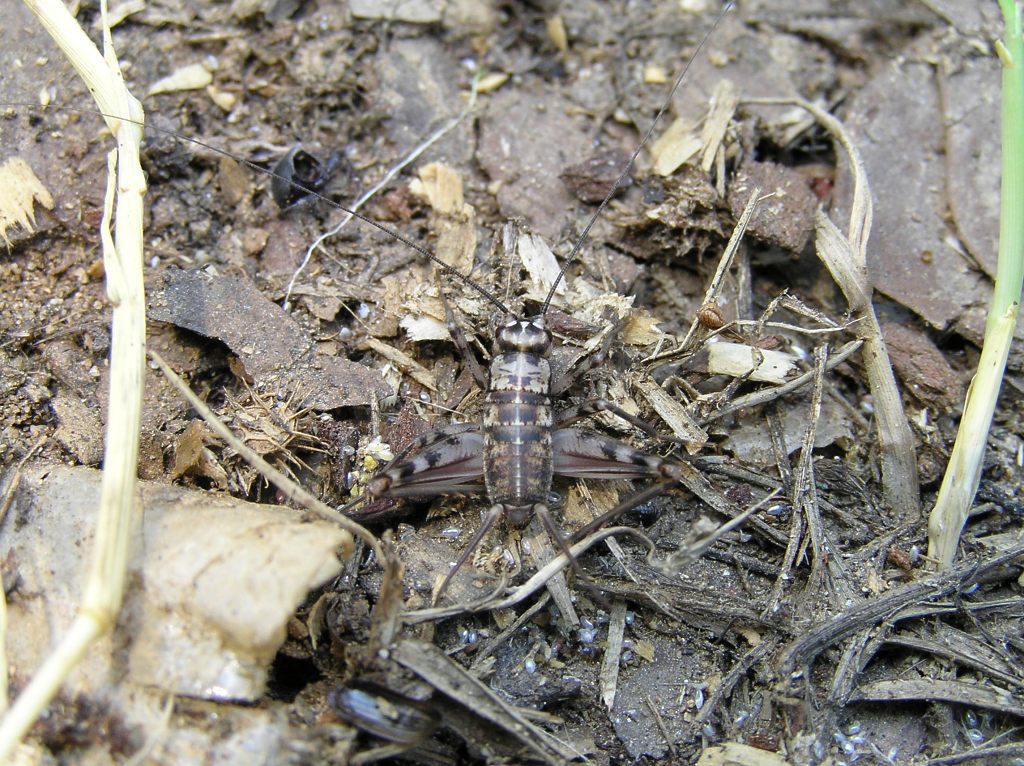
In 2002 Lance Chilton reported several Gryllomorpha type crickets under flat stones in woodland above Panagia and Potamia. A specimen I collected in 2005 from Potamia appears to be Gryllomorpha dalmatina (Ocksay, 1832), which is the most likely candidate of the six species known from Greece, but further material will be required for microscopic examination to confirm the identity of this interesting discovery. As part of the major series Fauna Graeciae, the Hellenic Zoological Society has published a comprehensive treatment of the Orthoptera of Greece (Willemse 1984, 1985a, 1985b) but no such treatment of the Dictyoptera has been produced. However, it is evident that the island supports several native cockroach species, as well as the usual cosmopolitan introductions. Battiston et al. (2010) provide an identification guide with brief species accounts for the ten mantid species recorded from Greece (Ameles decolor, A. heldreichi, A. spallanzania, Bolivaria brachyptera [Crete only], Empusa fasciata, Geomantis larvoides, Iris oratoria, Mantis religiosa, Rivetina baetica and R. balcanica), of which five have been reported from Thasos. A comprehensive summary of the Orthopteran fauna of Thasos has been published (Lehmann et al. 2016), listing 46 confirmed species of Orthoptera and eight cockroaches and mantids from the island. A further four species are included in The Grasshoppers of Greece (Willemse et al. 2018) as occurring on Thasos - Acrometopa syriaca, Conocephalus fuscus, Decticus albifrons and Platycleis affinis - though the source of these records is not provided. Despite its title, this book also deals with all of the crickets and bush-crickets of Greece. It is richly illustrated with a key, genus descriptions, distribution maps and oscillograms and will undoubtedly encourage wider study of the Orthoptera of Greece.
ORTHOPTERA & DICTYOPTERA CHECKLIST
DICTYOPTERA: BLATTODEA Ectobiidae – Kalotermitidae - Rhinotermitidae Phyllodromica marginata (SCHREBER, 1781) Kalotermes flavicollis (FABRICIUS, 1793) Reticulitermes aegeus GHESINI & MARINI 2015
DICTYOPTERA: MANTODEA Mantis religiosa (LINNAEUS, 1758) Praying Mantis Empusa fasciata BRULLE, 1832 Ameles heldreichi BRUNNER VON WATTENWYL, 1882 Geomantis larvoides PANTEL, 1896 Iris oratoria (LINNAEUS, 1758) Mediterranean Mantis
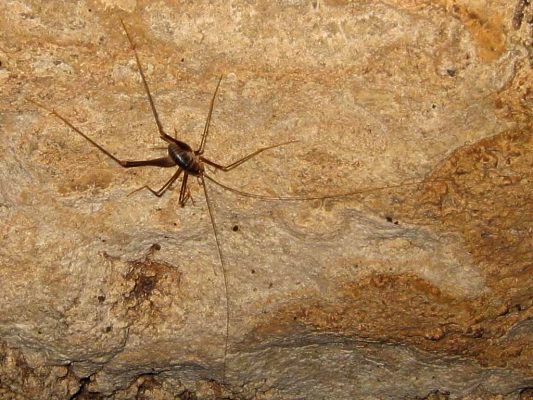
ORTHOPTERA: RHAPHIDOPHORIDAE Dolichopoda (Dolichopoda) thasosensis CHOPARD, 1964 Thassos Cave-cricket
ORTHOPTERA: PHANEROPTERIDAE Acrometopa [servillea] servillea (BRULLÉ, 1832) Serville's Long-legged Bush-cricket Acrometopa syriaca BRUNNER VON WATTENWYL, 1878 Mediterranean Long-legged Bush-cricket Tylopsis lilifolia (FABRICIUS, 1793) White Sickle Bush-cricket Leptophyes punctatissima (BOSC, 1792) Common Speckled Bush-cricket Poecilimon brunneri (FRIVALDSKY, 1867) Brunner's Bright Bush-cricket
ORTHOPTERA: TETTIGONIIDAE Conocephalus fuscus (FABRICIUS, 1793) Long Winged Cone-head Tettigonia viridissima LINNAEUS, 1758 Great Green Bush-cricket Decticus albifrons (FABRICIUS, 1775) Southern Wart-biter Decticus verrucivorus (LINNAEUS, 1758) Common Wart-biter Platycleis affinis FIEBER, 1853 Tuberous Bush-cricket Platycleis intermedia (SERVILLE, 1839) Intermediate Grey Bush-cricket Sepiana sepium (YERSIN, 1854) Red-faced Bush-cricket Platycleis (Incertana) incerta BRUNNER VON WATTENWYL, 1882 Uncertain Decorated Bush-cricket Eupholidoptera smyrnensis (BRUNNER VON WATTENWYL, 1882) Smyrna Marbled Bush-cricket Bucephaloptera bucephala (BRUNNER VON WATTENWYL, 1882) Red-headed Bush-cricket Rhacocleis germanica HERRICH-SCHÄFER, 1840 Mediterranean Bush-cricket
ORTHOPTERA: GRYLLOTALPIDAE Gryllotalpa cf. stepposa ZHANTIEV, 1991 Steppe Mole-cricket
ORTHOPTERA: MYRMECOPHILIDAE Myrmecophilus (Myrmecophilus) cf. myrmecophilus (SAVI, 1819) Mediterranean Ant-cricket
ORTHOPTERA: MOGOPLISTIDAE Arachnocephalus vestitus COSTA, 1855 Hairy Scale-cricket Pseudomogoplistes byzantius GOROCHOV, 1995 Eastern Beach-cricket
ORTHOPTERA: TRIGONIIDAE Trigonidium cicindeloides RAMBUR, [1839] Common Trig
ORTHOPTERA: GRYLLIDAE Oecanthus pellucens (SCOPOLI, 1763) European Tree-cricket Gryllomorpha dalmatina (OCSKAY, 1832) Common Crevice-cricket Acheta domesticus (LINNAEUS, 1758) House-cricket Gryllus campestris LINNAEUS, 1758 Common Field-cricket Melanogryllus desertus (PALLAS, 1771) Lesser Field-Cricket
ORTHOPTERA: TRIDACTYLIDAE Xya pfaendleri (HARZ, 1970) Pfaendler's Molehopper
ORTHOPTERA: TETRIGIDAE Paratettix meridionalis (RAMBUR, [1838]) Mediterranean Groundhopper Tetrix depressa BRISOUT DE BARNEVILLE, [1848] Dented Groundhopper
ORTHOPTERA: ACRIDIDAE Calliptamus italicus (LINNAEUS, 1758) Common Pincer Grasshopper Calliptamus barbarus (COSTA, 1836) Eurasian Pincer Grasshopper Pezotettix giornae ROSSI, 1794 Common Maquis Grasshopper Anacridium aegyptium (LINNAEUS, 1764) Egyptian Grasshopper Locusta migratoria LINNAEUS, 1758 Migratory Locust Oedalus decorus (GERMAR, 1826) Handsome Cross Grasshopper Oedipoda caerulescens (LINNAEUS, 1758) Blue Band-winged Grasshopper Oedipoda germanica (LATREILLE, [1804]) Red Band-winged Grasshopper Oedipoda miniata (PALLAS, 1771) Scarlet Band-winged Grasshopper Acrotylus longipes (CHARPENTIER, 1845) Yellow-winged Digging Grasshopper Acrotylus insubricus (SCOPOLI, 1786) Common Digging Grasshopper Acrotylus patruelis (HERRICH-SCHÄFFER, 1838) Slender Digging Grasshopper Aiolopus thalassinus (FABRICIUS, 1781) Slender Green-winged Grasshopper Aiolopus strepens (LATREILLE, 1804) Broad Green-winged Grasshopper Tropidopola graeca UVAROV, 1926 Greek Cylindric Grasshopper Acrida ungarica (HERBST, 1786) Common Cone-headed Grasshopper Dociostaurus maroccanus (THUNBERG, 1815) Moroccan Cross-backed Grasshopper Omocestus rufipes (ZETTERSTEDT, 1821) Woodland Grasshopper Chorthippus bornhalmi HARZ, 1971 Balkan Field Grasshopper Chorthippus parallelus (ZETTERSTEDT, 1821) Meadow Grasshopper
Species requiring confirmation (per Dr A. Lehmann): Sphingonotus caerulans L. Slender blue-winged grasshopper (this taxon, reported by Marinov, is probably referrable to S. rubescens (Walker, 1870)) Tetrix subulata (L.) Slender groundhopper ( reported by Marinov, subulata is possible on Thásos but confirmation is required) [note: Chorthippus brunneus Thunb., reported by Marinov, will be referrable to C. bornhalmi. Recent taxonomic research has shown the brunneus agg. to consist of several species and bornhalmi is the taxon represented in north-east Greece] REFERENCES Battiston, R., Picciau, L., Fontana, P. & Marshall, J. 2010. Mantids of the Euro-Mediterranean Area. WBA Handbooks 2. World Biodiversity Associations, Verona. Boudou-Saltet, P. 1982. Les Dolichopodes (Orth. Rhaph.) de Grèce. X. Le cycle biologique (en Elevage) des espèces D. petrochilosi et D. thasosensis. Biologia Gallo-Hellenica,9: 277-284. Chopard, L. 1964. Descriptions d'Orthoptères cavernicoles de Grèce. Bull. Soc. ent. Fr. 69: 17-20. Ciplak, B., Willemse, F., Chobanov, D. and Heller, K.-G. 2007. Systematic status and distribution of Eupholidoptera (Orthoptera: Tettigoniidae) in the Balkans (north of Central Greece). Articulata 22 (1): 33–46 Gorochov, A.V. 1995. Two new species of the genus Pseudomogoplistes Gorochov (Orthoptera: Mogoplistidae). Zoosystematica Rossica, 3: 249-250. Kaltenbach, A. 1965. Dictyoptera und Orthopteroidea von Nordost-Griechenland und der Insel Thasos. Annalen des Naturhistorischen Museums in Wien, 68: 465-484. Lehmann, A.W., Fowles, A.P. & Lehmann, G.U.C. 2016. Orthoptera, Mantodea and Blattodea from the North Aegean Island of Thásos, Greece. Articulata, 31: 93-112. Marinov, T. 1959. Beitrag zur erforschung der Orthopteren von der Insel Thasos und der Agäischen Küste. Izv. zool. Inst. Sof., 8: 279-283. Werner, F. 1938. Ergebnisse der achten zoologischen Forschungsreise nach Griechenland. SB. Akad. Wiss Wien, Mathen-naturw. Kl.,147: 151-173. Willemse, F. 1984. The Catalogue of the Orthoptera of Greece. Fauna Graeciae, Volume 1. Willemse, F. 1985a. Supplementary notes on the Orthoptera of Greece. Fauna Graeciae, Volume 1a. Willemse, F. 1985b. A key to the Orthoptera of Greece. Fauna Graeciae, Volume 2. Willemse, L. P. M., Kleukers, R. M. J. C. & Odé, B. 2018. The Grasshoppers of Greece. Leiden, EIS Kenniscentrum Insecten & Naturalis Biodiversity Center. 439 pp.
|

.jpg)